

By Paul Dunwell, writing for EasyFrame
© Copyright EasyFrame 2019
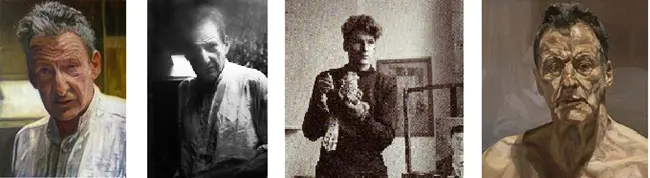
What this article is about
This article is about the figurative portraitist Lucian Michael Freud. By the end of the 20th century he had stepped out of the shadow of his famous grandfather, the psychoanalyst Sigmund Freud, to become a colossus of the art world. When he died he left £96m in his will for 10 of the 14 children he definitely left behind. There would have been more cash, but he could lose £1m a day gambling, and apparently paid off one Irish bookie with 23 paintings worth £100m. There were certainly more children, but those named were enough to raise an unholy hullabaloo about who got what.
Freud was unusual in style. He is best remembered as a figurative artist, somebody who represents real things, yet early in his career he dallied with surrealism too. So he had a foot in each camp. He's not easy to tag, but some call him 'expressionist'. (Others called him a lot worse.)
His life might also seem a mass of contradictions:
- He was German-born, yet volunteered for the Merchant Navy during WW2.
- He was thrown out of one school for being disruptive (driving a pack of foxhounds into a chapel during a service was the last straw) and burned down another, the East Anglian School of Painting, supposedly by accident. Goldsmiths took him in anyway, which was rather brave of them.
- He knocked around with a disreputable crowd that included the artist Francis Bacon, the Spectator journalist Jeffrey Bernard and the performer Leigh Bowery.
- He could be violent. He punched Prime Minister Harold Macmillan's son in the mouth for urging him to treat his wife better, and allegedly asked the Kray twins to beat up the gossip columnist David Litvinoff for pretending to be Freud in bars to put drinks on his tab.
- He was a serial philanderer who may have fathered as many as 40 children. Yet he was 'establishment' enough to paint the Queen. She didn't commission him, but agreed to his request, with controversial results she may well have regretted.
- He was Jewish, and his grandfather famously believed God was an illusion born of an infantile need for a father figure. Yet his private funeral was presided over by Rowan Williams, the Archbishop of Canterbury, to whom he was related through one of his children.
Hopefully that's whetted your appetite. But there's more!
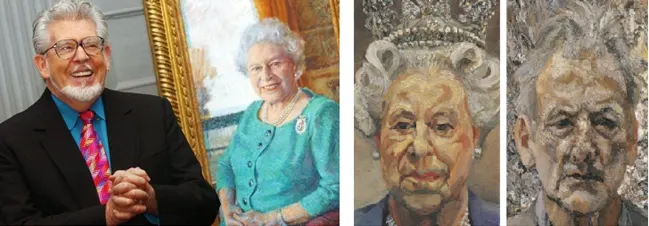
Early life
Freud's father Ernst was an architect and Sigmund Freud's youngest son. His mother Lucie was an art historian and the daughter of a rich grain merchant. The family fled Germany in 1933 to escape the anti-Semitism that accompanied Hitler's rise to power.
The family was wealthy, and Lucian, the middle son, was apparently a spoiled brat and a pretentious snob. He spent much of his early adulthood drinking (and driving his Bentley erratically at speed), betting (he failed to pay gambling debts of £20,000) and swanning around in a fez and fur coat with a bird of prey on his wrist.
His younger brother was Clement Freud, who became a famous chef, writer and politician with a dour sense of humour. It seems they hardly spoke after a childhood race that Clement was winning, when Lucian yelled 'Stop thief!' and won by default. Lucian was also estranged from his elder brother Stephen, an ironmonger, until Clement died.

Lucian did know his grandfather, because Sigmund visited London regularly for treatment after he contracted cancer.
An odd adult
Lucian joined the Merchant Navy at 20, which might have instilled a little discipline, but he was invalided out after three months. He has been called something of a 'mummy's boy'. He certainly spent 4,000 hours painting his mother in the 1970s (2,000 hours is a working year for most people).
He was always odd. He apparently hated the telephone and could in effect be contacted only by telegram until 1982. He avoided people unless it was for sex.
The oddness is reflected in his work. Freud himself might not have been sure what was going on in his own head, and it's too late to ask him. Even his grandfather might have been stumped. But it looks as if he had a poor opinion of those around him, and maybe of himself and his own life too.
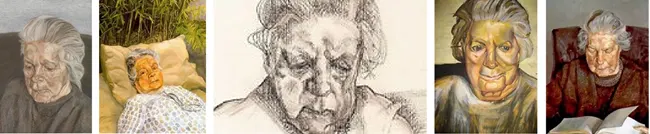
Models
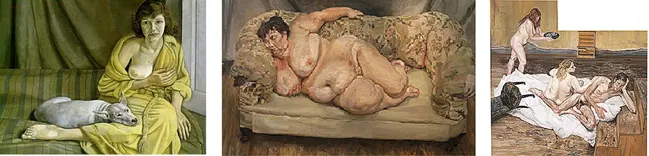
At first, with nobody to sit for him, Freud drew and painted inanimate objects, including dead monkeys from a local pet shop, a stuffed zebra's head and a palm. That changed.
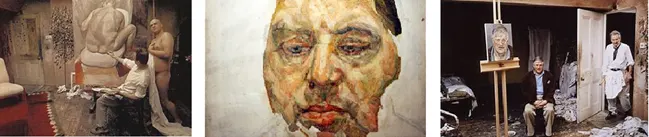
Freud frequently painted nudes, and many of his sitters were gay men, whose bravery he apparently admired. He himself has been described as 'notoriously heterosexual'.
It has been said that he painted like a pathologist (remember the dead monkeys?), and there is an enduring impression that his models are lifeless. Freud flattered nobody: not the Queen, and not even himself. In this he had much in common with Francis Bacon, a friend until they fell out. Both could depict human flesh, often in reds and dirty grey-whites, as if it were nothing more than meat.
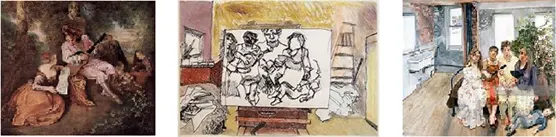
Freud usually began with charcoal, working on the head first, and then added colour. His 'Large Interior W11' shows this, and there the models were family members. He applied huge amounts of paint but cleaned his brush after every single stroke. As a result some works took as long as 16 months and 2,400 hours. Even then he would insist on reworking a piece of fabric if he felt he hadn't done it justice.
Recognition
Freud is considered one of the luminaries of the London School, which also included the figurative artists Francis Bacon, Reginald Gray, Robert MacBryde, Robert Colquhoun, Frank Auerbach and Michael Andrews. He was a visiting tutor at the Slade School of Fine Art at University College London. In 2012 Peter Blake included him in the reprised cover of the Beatles' 'Sergeant Pepper's Lonely Hearts Club Band'.
Conclusion
Lucian Freud's work will stay popular, and even a print is likely to hold its value. To find out how to obtain his work, go to www.myartbroker.com/artist/lucian-freud/ or the Tate's page at www.tate.org.uk/art/artists/lucian-freud-1120.
You'll need it framing. Unless you know your stuff when it comes to picture frames and mounts, it's worth going to experts. EasyFrame is an obvious and affordable supplier, whether you want everything you'd need to do the job yourself or would rather they did it for you. Any good framer will show you a range of solutions and advise on what suits the work and where it will hang.
EasyFrame is on 01234 856 501 and sales@easyframe.co.uk, and they'll always chat even if you don't want to buy!