

By Paul Dunwell, writing for EasyFrame
© Copyright EasyFrame 2020
What this article is about
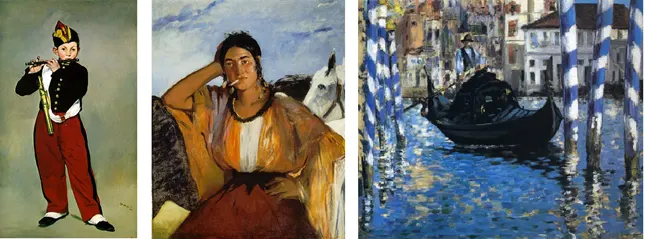
This article is about the innovative French painter and printmaker Edouard Manet (1832-83). He is sometimes credited with being the father of modernism, and one of the artists, if not the artist, whose work began the transition from realism to impressionism.
Manet was famous for working quickly and roughly, putting the paint on in a slapdash way and often finishing a work in a single sitting. That was at odds with the tradition of painstakingly building up layers of oils, and his results looked a little flat by comparison. Look carefully and you'll see he also put black outlines on figures. His approach wasn't everyone's cup of tea, so it was commercially risky. But he came from a privileged background and didn't have to pander to the public to keep the wolf from the door. Even so, he won recognition within his relatively short lifetime.
Manet should not be confused with Monet, though it often happens. Both were born in Paris. They were contemporaries and friends with similar skills and approaches. But Claude Monet was born 8 years later and lived much longer, which is why he left a larger legacy, and it was his 'Impression, Sunrise' that gave the impressionist movement its name.
Early days, education and inspirations
Manet was born in an ancestral mansion to an affluent, politically well-connected family. His mother, Eugénie-Desirée Fournier, was related to Swedish royalty. His father, Auguste, was a judge who expected his son to become a lawyer. His uncle, Edmond Fournier, had other ideas. He took the boy round the Louvre and later enrolled him on a drawing course, where he met a future Minister of Fine Arts who became a lifelong friend.
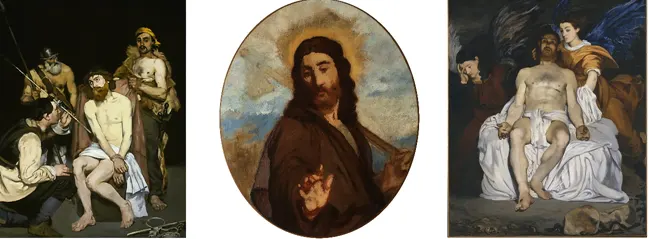
Despairing of the law, Manet senior tried to steer his son into the navy. Young Manet failed the entrance exam twice. At that point his father seems to have thrown in the towel and let Edouard, now 18, study for six years under the academic painter Thomas Couture. A keen student, he copied works in the Louvre in his spare time.
From 1853 to 1856 he visited Italy, Germany and the Netherlands. His key formative influences became the Dutchman Hals and the Spaniards Goya and Velázquez. By 24 he was ready to open his own studio. He went on to form friendships with Monet, Renoir, Sisley, Cézanne, Morisot, Corot, Pissarro and Degas.
What did Manet paint?
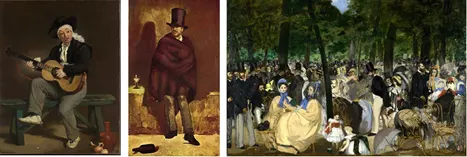
Manet moved from traditional, religious and classical early works to a preoccupation with bars, beggars and bullfights, gypsies and good-time girls, absinthe and asparagus, cafés and singers. He was also interested in war, and in subjects that were risqué for their day, though tame by modern standards.
Manet's rise to prominence
Increasingly he painted subjects that reflect a taste for hedonism, as 'The Spanish Singer', 'The Absinthe Drinker' and 'Music in the Tuileries' all show.
'The Luncheon on the Grass' ('Le Déjeuner sur l'herbe', originally called 'The Bath') was rejected by the influential Paris Salon in 1863. That allowed it to be shown at the alternative Salon des Refusés (Salon of the Rejected) in the Palais des Champs-Elysées, which Napoleon III had dreamt up to encourage the many artists turned down by the selection committee. Stung by the rejection, most of those artists didn't take up the opportunity. Manet knew better.
He had hired a model and posed her with his future brother-in-law Ferdinand Leenhoff and one of his own brothers. Fully dressed men with a naked woman echoed a composition originally by Raphael, and Manet apparently borrowed from Giorgione and Titian too. So it was something of a composite, and proof that he had been soaking up his art history in the Louvre. The subject was always going to raise eyebrows, and Manet was not above that.
Manet's life
Manet married Suzanne, his former piano teacher, only after his father died. The paternity of her son has long been debated: the father may have been the artist, or possibly the artist's own father. It isn't clear.
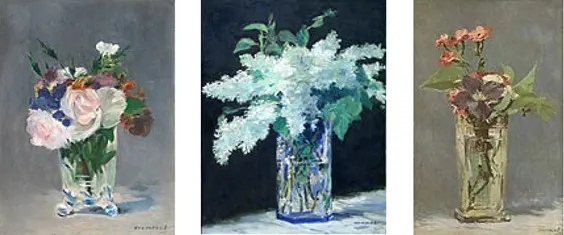
In his forties he began to suffer what were probably the symptoms of syphilis. They affected his spine and legs and limited his mobility, so he ended up painting flowers at home. Even that was cut short when he had a foot amputated for gangrene. He did not live long afterwards.

Conclusion
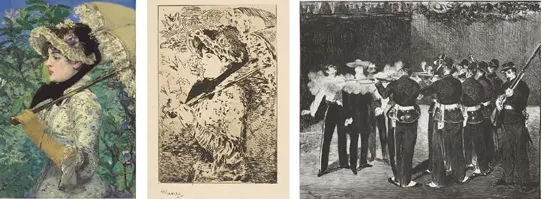
Manet was a versatile game-changer, and his work is good enough to grace anybody's walls. Nobody expects you to buy an original, though he left almost a thousand works. The most expensive Manet to date seems to be 'Le Printemps', which the J. Paul Getty Museum bought for .1m.
High-resolution prints are available, though. One excellent source of unframed prints is https://artuk.org/shop/artists/edouard-manet.html
You'll want to frame whatever you buy. Any good framers will show you a range of solutions and advise on what suits the work and where it will hang. EasyFrame is on 01234 856 501 and sales@EasyFrame.co.uk, and they'll always chat even if you don't want to buy!