

By Paul Dunwell, writing for EasyFrame
© Copyright EasyFrame 2020
What this article is about
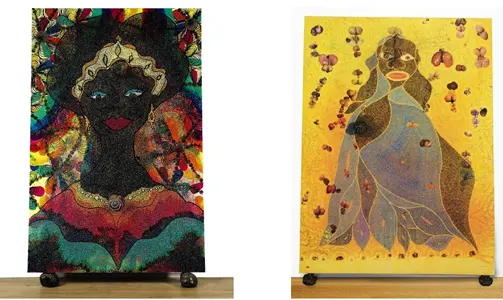
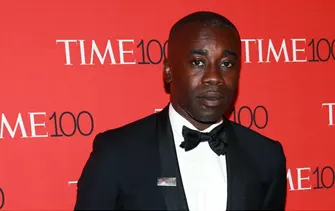
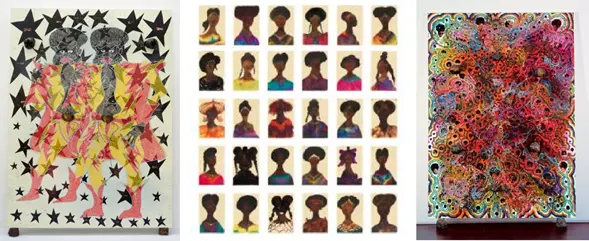
This article is about Chris Ofili, a controversial British painter of Nigerian heritage. In 1998 he became the first black winner of the Turner Prize, with a body of work including 'Orgena'. It was the first time a painter had won since 1985. He had risen to prominence as one of the Young British Artists, though his work is distinctly different from that of his contemporaries.
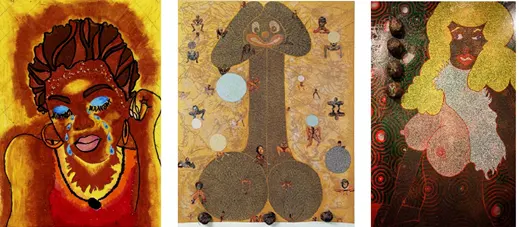
He has been branded a 'punk artist' for his liberal use of cuttings from pornographic magazines, glitter and elephant dung, and for the sexual imagery in works such as 'Holy Virgin Mary'. Yet he has sat on the Tate's board of trustees, and in 2017 he was awarded a CBE for services to art. So he has become an establishment figure against the odds, and despite his evident willingness to shock. (He shocked the Royal Academy too, by refusing membership on the grounds that the honour was worthless if it didn't come with a free parking space.)
Education and early success
Chris Ofili was born in Manchester, 3 years after his parents arrived in Britain. Both worked for McVitie's biscuits, so the family was not privileged. When Chris, the 2nd eldest of 4, was 11, his father left to set up a new home and family back in Nigeria.
Even so, he won successive places at St. Pius X High School for Boys, Xaverian College, Tameside College, Chelsea School of Art (for a Bachelor's degree in Fine Art), the Royal College of Art (for a Master's) and Berlin's Universität der Künste.
He was one of the Young British Artists, the YBAs, who first emerged from Goldsmiths in 1988 and later drew in students from the Royal College of Art. They included 'shock-tactic' artists such as Damien Hirst and Tracey Emin, who often exhibited in factories and warehouses, are credited with revitalising British art and almost invariably enjoyed the patronage of the advertising tycoon Charles Saatchi. Ofili did not exhibit at the big YBA show 'Freeze', but he did at its successor, 'Brilliant!'. Much of his work is in oils, though there are watercolours too.
Ofili's influences
His influences are various. He has studied cave paintings in Zimbabwe, been fascinated by blaxploitation movies, and absorbed Caribbean culture in Trinidad's Port of Spain, where he now lives, though he has homes in London and Brooklyn. His bright colours and decorative work have been likened to those of Robert Colescott, Kerry James Marshall and Ellen Gallagher.
Ofili was raised a Catholic and was an altar boy, and quite a bit of his work has religious undertones. He has always loved hip-hop and was a promising young footballer. Race and identity have obviously been important to him, though he has said he has no interest in tracing his roots. The Stephen Lawrence inquiry is cited as the inspiration for 'No Woman No Cry'.
How his work caused a stink
Ofili caused international outrage in 1999, when New York's Brooklyn Museum was about to show 'Holy Virgin Mary', which features a black Madonna, elephant dung and sexual imagery. The city's archbishop, Cardinal John O'Connor, was outraged at what he saw as mockery of the virgin birth. Donald Trump called it 'degenerate'.
More seriously, the mayor, Rudy Giuliani, condemned it as 'sick', launched a lawsuit and announced: 'There's nothing in the First Amendment that supports horrible and disgusting projects'. (The First Amendment to the US constitution protects freedom of religion and of speech.) He threatened to withdraw the museum's funding, which would have forced it to close.
Ofili felt threatened and largely withdrew from public life. For the most part he stays in Trinidad, where he keeps a low profile.
Further controversy
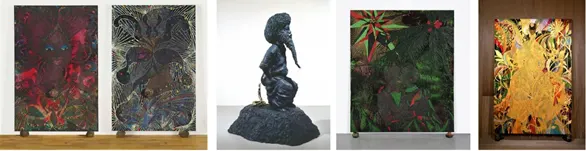
In 2005, while Ofili was one of its trustees, the Tate rather unwisely bought 'The Upper Room', an installation of 13 of his framed paintings, each featuring a rhesus macaque monkey. A year later the Charity Commission censured the Tate, citing what should have been an obvious conflict of interest, and Ofili stepped down as a trustee.
Conclusion
Chris Ofili is a unique individual who has forged his own way to fame and fortune without riding on anybody's coat-tails. The Tate is currently showing his work in what is considered a 'mid-career' exhibition (see www.tate.org.uk/art/artists/chris-ofili-2543). You can also see his work at the Saatchi Collection on the King's Road in London, the Museums of Modern Art in New York and San Francisco, the Los Angeles Museum of Contemporary Art, the Walker Art Center in Minneapolis and the Carnegie Museum of Art in Pittsburgh.
For an exhaustive and fascinating biography, go to http://chrisofiliprints.info/biography.php?cur=GBP. Nobody expects you to buy an original, but fine prints are available. One excellent source of signed prints, which may well appreciate in value, is http://chrisofiliprints.info/.
You'll want to frame whatever you buy. Any good framer will show you a range of solutions and advise on what suits the work and where it will hang. EasyFrame is on 01234 856 501 and sales@EasyFrame.co.uk, and they'll always chat even if you don't want to buy!