

Items 0
Total Price
Loyalty Points
By Paul Dunwell, writing for EasyFrame
© Copyright EasyFrame 2020
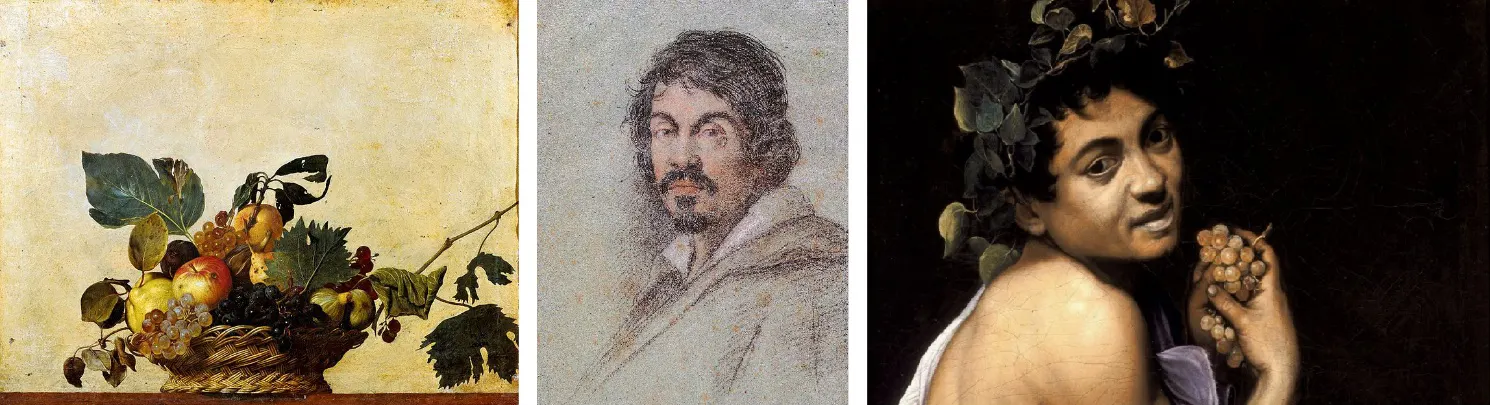
This article is about Caravaggio, whose full name was Michelangelo Merisi da Caravaggio and who lived from 1571 to 1610. He was named after the village near Milan from which his family came. A formidable talent, he brought unprecedented psychological realism to painting, together with a new way of accentuating light and shadow. Some credit him with single-handedly launching the baroque era, others with being the spark from which modern art grew.
His art seems inseparable from his capacity for violence and from a private life that scandalised his age. He would probably have met his end much sooner had he not been such a prodigious talent. He spawned many imitators, the 'Caravaggisti', and his work has long been embraced by gay audiences.
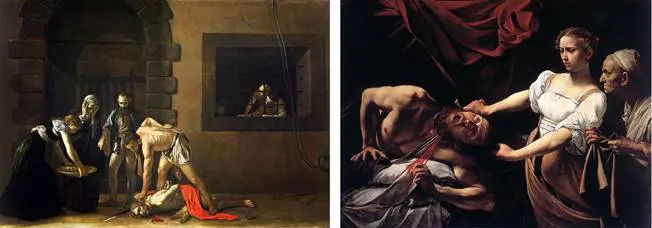
Caravaggio was born in 1571. When he was six, most of his family, including his father and grandfather on the same day, were killed by the bubonic plague, even though they had fled Milan for Caravaggio to avoid it. It was in any case a violent age.
After his mother died he was taught in Milan for 4 years, from the age of 13, by Simone Peterzano, a pupil of Titian. He turned up penniless in Rome at about 20, having fled Milan after a series of spats and an assault on a police officer.
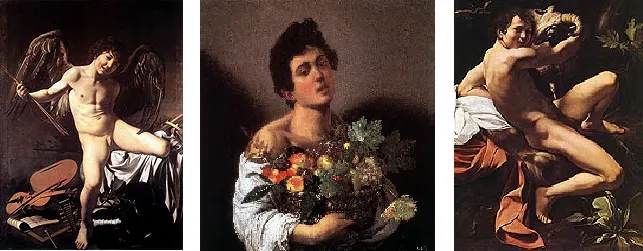
In Rome he churned out formulaic 'flowers and fruit' pieces to order in the studio of Giuseppe Cesari, Pope Clement VIII's favourite artist. Even these he painted realistically. Early works such as 'Boy Peeling a Fruit' (his earliest known painting), 'Boy with a Basket of Fruit' and 'Young Sick Bacchus' have all withstood stringent botanical analysis. Characteristically, he fell out badly with Cesari.
He was an almost perpetual visitor to the courts. When he was sued for libel by the rival artist Giovanni Baglione, evidence about his private life came out in court. He seems to have had a relationship with a young male assistant called Cecco, and he also frequented courtesans. Many of his lovers, along with beggars and thieves, found their way into his paintings, as he did himself. He never married or had a child, and he never painted a female nude.
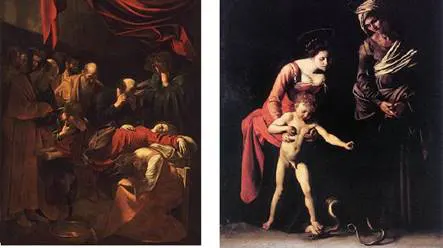
Caravaggio painted from live models at quite a pace, without preliminary sketches. That caused trouble, since much of his work was for Catholic churches. The Carmelites recognised the model in 'Death of the Virgin' as a well-known prostitute and rejected it. Of 'The Madonna of the Grooms' a cardinal's secretary wrote: 'In this painting there are but vulgarity, sacrilege, impiousness and disgust... One would say it is a work made by a painter that can paint well, but of a dark spirit, and who has been for a lot of time far from God, from His adoration, and from any good thought...'
His circle included the architect Onorio Longhi, with whom he shared a love of street brawling. Caravaggio was involved in endless arguments, often with a sword at his side. In 1606 he killed a young man called Ranuccio Tomassoni, possibly by accident, possibly over a gambling debt, a game of tennis or a woman. He fled Rome, where he had become the most famous painter, for Naples, where he was soon seen as equally unrivalled.
Until then influential families had protected him, on account of his father, who had been an administrator, architect and decorator. He had now become a liability even to them.
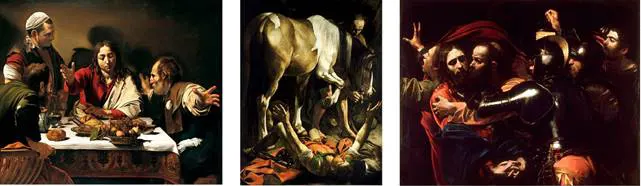
Caravaggio moved on to Malta, where in 1608 he battered down the door of an aristocratic knight and severely injured him. He escaped from prison and fled to Sicily.
His behaviour, never good, was deteriorating. He was apparently so fearful that he slept fully clothed and armed. He would rip up paintings if anyone criticised them, and he picked fights with anyone. Lead poisoning may have played a part, since many paints of the time contained lead, and he may have had syphilis.
After knights who had tracked him from Malta ambushed him and left his face disfigured, he decided to flee back to Naples. He took 3 paintings to give to Pope Paul V as a blatant bribe for a pardon. It worked, or looked as if it was going to.
In 1610, somewhere between Naples and Rome and on his way to be pardoned, Caravaggio died. The cause may have been lead poisoning, syphilis, malaria, brucellosis (from unpasteurised dairy products) or sepsis from wounds received in one of the vendettas that dogged him. It is also possible that he had simply become too much of an embarrassment to his patrons.
Caravaggio could paint light as nobody before him had done, though he was usually in a dark place. He left between 40 and 80 works, depending on who you ask, each worth between £20m and £100m. Whatever one thinks of him as a person, it is an impressive legacy.
Nobody expects you to buy an original, but fine prints are available to frame. One excellent source is the National Gallery at www.nationalgallery.co.uk/products/caravaggio.
You'll want to frame whatever you buy. Any good framers will show you a range of solutions and advise on what suits the work and where it will hang. EasyFrame is on 01234 856 501 and sales@EasyFrame.co.uk, and they'll always chat even if you don't want to buy!
Article Posted: 18/02/2020 06:43:15